


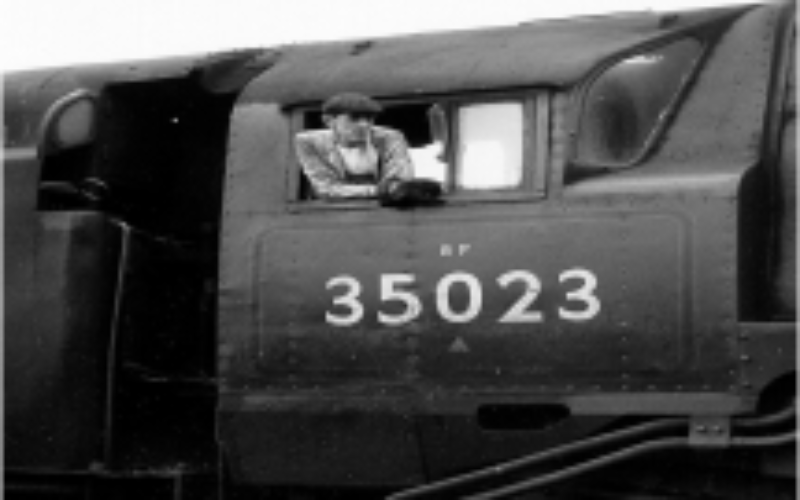
With our flagship locomotive ‘Canadian Pacific’ in her final stages of restoration we are taking a look back at some of the fantastic stories about this important locomotive, the oldest and fastest survivor of her class.
Below is the story from fireman Dave Wilson, who was on the footplate of ‘Canadian Pacific’ back on the 15th May 1965 when she reached 105mph just outside of Winchester:
Beyond the nicknames, banter, cans of tea and cheese and pickle sandwiches the mess-room at Nine Elms also bred a rivalry in the running of trains. It was ambitious rivalry which was largely responsible for the very fine enginemanship in those last two years of mainline steam hauled services. Gordon Hooper, Gordon Porter and Eric Saunders were all Three link drivers in 1965 – and it is their names which crop up over and over, (between them more than thirty appearances in the performance tables covering the South Western section), in D.W.Winkworth’s book Bulleid’s Pacifics.
In late Spring of 1965 the beginning of the end of ‘Southern Steam’ begins with a run from Waterloo to Basingstoke. On 15th May 1965 I was rostered to work the 21-20 ex-Waterloo, the driver was not my regular mate Eric ‘sooty’ Saunders, but another of three link’s drivers Gordon ‘madman’ Hooper. Driver Hooper had earned his sobriquet not for any reasons of insanity but for his fast and fearless running and I was about to discover just how ‘fast and fearless’ that was. Revised schedules were being introduced from mid-June 1965 with the commencement of the Bournemouth line ‘electrification’ – the crews at Nine Elms knew that once that juice rail started it was all up for the steam hauled mainline express.
Our engine that night was one of preservation’s finest – MN class No.35005 Canadian Pacific, the load behind the tender was ten coaches and the evening was fine and dry. Being only the fireboy I, of course, had no idea of what was about to happen and driver Hooper gave no direct indication that record setting was on the agenda. The 360-ton load was light for a ‘Packet’ and No.35005 was in fine fettle.
The route from Waterloo to Basingstoke has no major banks but, it is mostly rising gradients throughout its length. A brief summation of the route would be that a little under four miles out of Waterloo comes Clapham Junction and a permanent speed restriction followed by a short climb up to Wimbledon from there the running is fairly level to Byfleet Junction from where the line climbs to milepost 31 before a short dip down towards Farnborough were the line again takes on a slightly rising gradient almost to the outskirts of Basingstoke.
On the night No.35005 ran from Waterloo to Basingstoke in 43 minutes 48 seconds, 41 minutes’ net, that’s 47.8 miles, start to stop, mostly against the grade – not bad going, but, more was to come. After leaving Basingstoke driver Hooper continued in the same cavalier style and No.35005 reached 105mph on the descent to Winchester – not the highest speed attained by a Merchant Navy but well in the top ten. However, it was not the 105mph which was to become the yardstick but the 41-minute net time for the start to stop journey between Waterloo and Basingstoke.
The 21.20 ex-Waterloo was not a regular Three link turn, but the 17.30 departure was and like the 21.20 it was also first stop Basingstoke. The impending slowing of the timings and the inevitability of engineering works and their attendant speed restrictions once the ‘electrification’ began meant that any attempt to meet ‘Madman’ Hooper’s challenge ‘get to Basin’ in 40 minutes’ was going to have to happen ASAP.
Bulleid pacifics are very much a ‘like ‘em or loathe ‘em kind of engine – as someone who fired, and on occasions drove (unofficially) them, over much of the former LSWR I am definitely one of the former persuasion. Despite the abuse and neglect these engines were subjected to as steam came to an end on Southern metals the performances speak volumes for their power and durability – performances in preservation have served only to confirm this reputation.
-Dave Wilson

