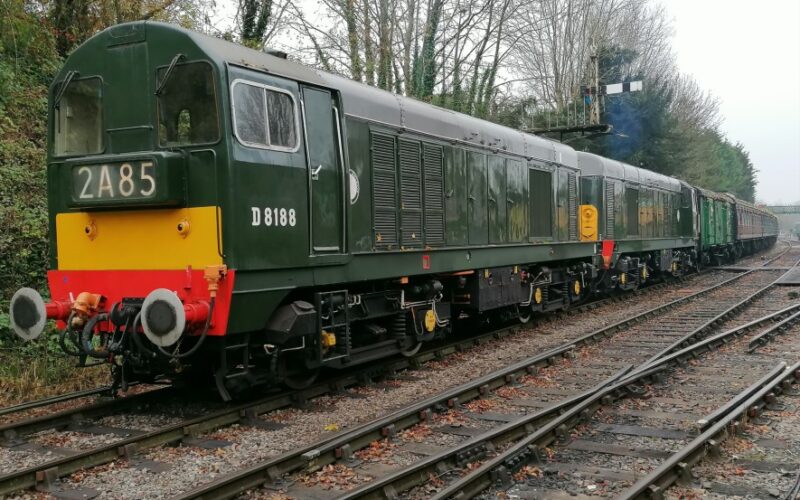
With the publication of the British Railways Modernisation Plan came the planned withdrawal of steam traction on Britain’s railways. As a result, British Railways placed tenders with several locomotive manufacturers to produce diesel locomotives.
As a result of this, the English Electric Company (EE) in 1957 at the Vulcan Foundry in Newton le Willows produced a batch of 20 English Electric Type 1s (or Class 20 locomotives as they would later become) for evaluation. The design was based on one which EE had designed for export and consequently proved extremely successful at home. The prototype batch was first allocated to Devons Road Depot in London (which was the first purpose-built diesel depot in the UK), and the locomotives of this class were eventually used throughout almost the entire network.
Weighing 73 tonnes and delivering 1,000 horsepower, it was designed to work light mixed freight traffic at up to 75 mph. It has the well-used nickname of “Chopper”, due to the distinctive engine beat under load, which resembles the sound of a helicopter.
The design was immediately successful with a further 108 production examples ordered. The first and second series can be identified easily by having the white headcode discs on the front and rear to indicate to signal boxes which classification of train they were working.
Overall, the move to diesel power for British Railways wasn’t going well, with many of the prototype designs proving unreliable. Of all the types, the EE type 1s were proving very reliable, and as a result, the British Railways board ordered a further 100 locomotives in 1966 (making a total of 228). The last batch, or “New” locomotives as they were known, can be identified by the Four Character headcode box in the front to indicate the train’s headcode to the signalman. 1M35 indicates a Class 1 train (express passenger), M means it to bound for the Midland region, and it is number 35 in the Working Timetable.
The type was used a great deal on Merry – Go – Round (MGR) coal trains, whereby the trains never actually stopped whilst loading coal at the colliery and also discharging the coal at the power stations. The locos were modified with “Slow Speed Equipment” to be able to maintain a steady 1.5 mph through this process. The demise of the coal industry saw the demise of the class, though some still operate on the National Network for private operators.
We are lucky to have an example of both production types of these versatile locomotives, and from time to time operate them in multiple, where both can be driven by one Driver.


D8059 (20059) was built by Robert Stephenson & Hawtorn Ltd, Darlington in 1961, being delivered new to Sheffield Darnell shed in the May of that year. In 1964, 8059 was transferred to the newly opened Tinsley depot in Sheffield, where she would remain until April 1968, when a move to Toton took place. The next few years saw 20059 move between Tinsley and Toton depots.
Between March 1985 and November 1986 the loco was renumbered into the 20/3 sub class following some brake modifications, the loco becoming 20302. This proved to be short lived and reverted back to 20059. Withdrawal from service came in 1993 after finishing in EWS (English, Welsh & Scottish) service, followed by a period in store at Margam, South Wales.
The loco was purchased by the Somerset and Dorset Locomotive Company initially moving to Yeovil Junction for restoration. 20059 has subsequently visited a number of preserved railways, including a spell on the Severn Valley Railway.
D8188 (20188) was built by the English Electric Company’s Vulcan Foundry at Newton-le-willows at the end of 1966. She was allocated new to Nottingham Division at Toton, entering service on 21st January 1967 and remained in service there until withdrawal in January 1990
The locomotive was renumbered to 20188 on 1 January 1973 under TOPS.
Following withdrawal from service 20188 was purchased by Waterman Railways, and during 1995 it starred in the James Bond filmed “Goldeneye”.
In 2000, the locomotive was sold to the Somerset and Dorset Locomotive Company, moving initially to the Watercress line, then the Swanage railway before a move to the Severn Valley Railway.


