Notes
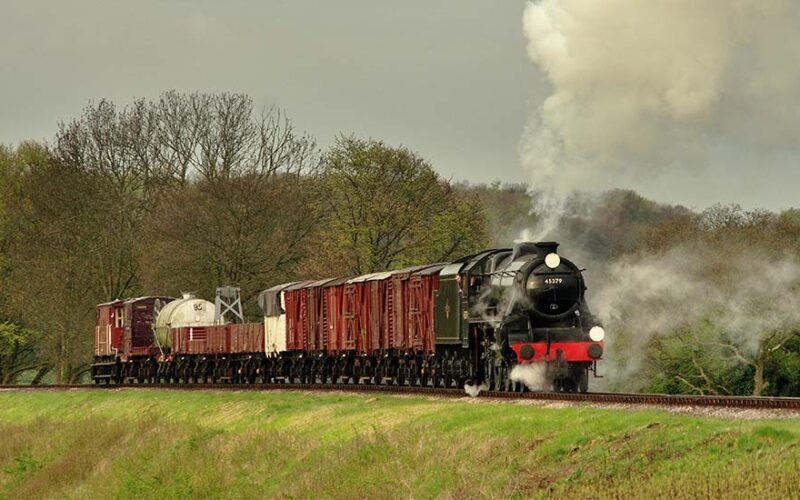
The Mid Hants Freight train aims to be typical of those operated in and around Hampshire circa 1960. This period ties in with the heritage setting at the railway and many of our wagons were then newly built, introduced by British Railways as a result of the “1955 Modernisation” plan. At this time older wagons from the pre 1948 nationalisation period were also operating.
In 1960 virtually every railway station in the country had its own goods yard with a daily goods train bringing in coal for the local coal merchants to deliver to our homes, new agricultural equipment and fertiliser for local farms and taking out the produce to markets in London and beyond. Butter, timber, beer, cattle, fruit, grain, wine, meat, oil, manure, cement, chocolate, watercress and almost anything else you can think of was carried by the local goods train.
From here local goods trains ran to and from the bigger yards such as Woking, Guildford, Basingstoke, Eastleigh and Salisbury. Here the wagons were shunted out into the next stage of their journey to Nine Elms, the massive Feltham marshalling yard, Exmouth Junction, Southampton docks or indeed off the Southern to other marshalling yards at Willesden, Brent, Temple Mills, Bescot, Tinsley and Severn Tunnel Junction.
In 1960 there were over 1,000,000 goods vehicles and containers on British Railways and the average turn round time of a wagon from load to load was some 10 days. It may not have been particularly efficient compared to today and indeed many country goods yards only handled a few wagons a week.
However, freight revenue in 1960 was almost double the income from passenger traffic on BR. Few people realise how important freight was at this period – reflective of industries and traffic which have now largely disappeared or transferred to road. The goods yards on the Mid Hants line closed at Ropley and Itchen Abbas in 1962 and at Alresford and Medstead in 1964. Alton remained opened until 1968.
The Mid Hants Railway Wagon Restoration
The current Wagon Group has bases at both Alton and Medstead. Here most of the wagons running today have been restored, and are maintained, by about 20 working volunteers. You can find out more about their work by following their blogs. There are around 30 wagons (plus containers) which can run in the demonstration Freight trains. However, as the length limit of the run round loop at Alton is 21 standard length wagons, they cannot all run at once! But this does mean that there is plenty of scope to alter the rake of operational wagons as required.
In addition to the wagons themselves we try to recreate an authentic looking train restoring appropriate loads for wagons – these including a coal crane grab from Eastleigh, cable drums from Pirelli at Eastleigh, BR “A” and “AF” type containers and a unique new build reconstruction of a BR “D” type open container.
Click here to view a film about the Wagon Department.
The circa 1960 period authenticity of the wagon fleet is enhanced by:-
- Correct painting, lettering and numbering of wagons and containers.
- Slight variations in the BR bauxite and grey liveries to indicate the effects of weathering and aging since the last “BR” repaint.
- Authentic loads on authentic wagons, which are also correctly roped or chained down.
- Authentic “customer labels” pasted to the sides of several vans – ie BOCM (animal feeds); Biscuits from Carr’s of Carlisle; and Caria Cairn Dog Food.
- Evidence of straw packing from a previous load protruding from van doors.
- Chalked on shunter’s markings to the sides of wagons.
The freight train is currently timetabled to run a number of Sundays a year and at the Spring and Autumn galas. It is also used for Footplate Experience days and photo charters – currently running in total around 600 miles a year.