


Camping Coaches at East Budleigh Station, Devon in the early 1960s. See Greg Freeman’s memories below
These accounts of travelling by train were all collected as part of the Canadian Pacific Outreach Project. To qualify for that, they needed to be on routes that locomotives like ‘Canadian Pacific’ would have worked, so London to Dover boat trains and the west country routes from London to Hampshire, Dorset, Somerset, Devon and Cornwall.
We will add more and welcome contributions. Please contact Keith via kchambers@hotmail.co.uk for further information.
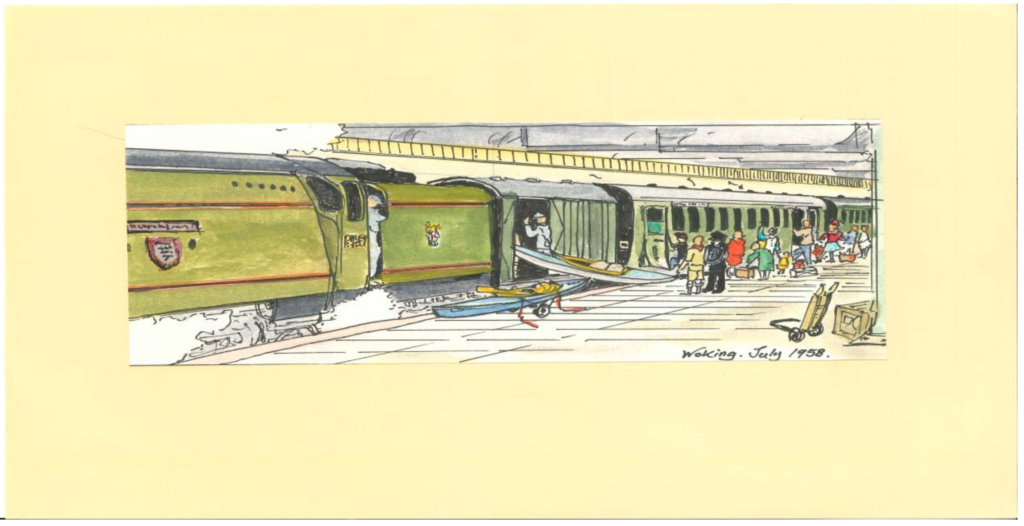
Canoes by Train
In 1958 I was an engineering apprentice at Vokes Ltd, at Henley Park. Whilst on day
release to Guildford Technical College I met up with another engineering apprentice from
Dennis Brothers of Guildford. We found that we had a common interest in canoeing
and canoe touring, and because both companies closed down for the same two weeks in
summer, we planned that year to make a sea canoeing trip along the south Devon coast,
starting from Exeter and hopefully ending in Plymouth.
As we lived in St. Johns near Woking and Farnham respectively, the first question was how to
transport the two sixteen-foot-long rigid wooden framed canvas covered canoes to Exeter,
and two weeks later, back again from Plymouth? We decided that the best solution would
be to take them by train, if possible, so we duly went along to Woking station to make
enquiries. At that time, as far as I can recall, rail passenger’s bicycles, folding canoes, and
luggage in general went free, but we were not so sure that this would apply to our rigid
non-folding canoes. However, it’s not a problem, were told, and all we had to do was to
decide which train we would like to travel on from Woking to Exeter, and that British Rail
would then arrange for a suitable longer passenger luggage van [PLY] to be attached to that
train.
For the envisaged return journey from Plymouth back to Woking, the canoes were to be
taken to the luggage office at the railway station in Plymouth, and they would then put them
on the next available long PLV That would be some time after we had travelled back on a
routine passenger service train, and we would be advised when the canoes were available
for collection from Woking station.
We purchased passenger tickets, for the 09.00 Waterloo to Exeter train on the third
Saturday in July, and as I recall, there was no additional charge for the canoes or the long
PLV And so it was on that Saturday morning of the last week in July we wheeled the
canoes on their little folding trolleys, down from my friend’s home in St. Johns to Woking
station, and on to the platform, to await our “special” train. It duly arrived on time, hauled
by a West Country class locomotive and complete with the long PLY. We duly arrived at
Exeter Central where we off-loaded the canoes, assembled the trolleys and wheeled them
down to the quayside on the river Exe. Here we launched and set off on our voyage.
We did not reach Plymouth as planned, because bad weather with high winds and seas set
in during the second week, and we were unable to round Prawle Point, the most southerly
and exposed point on the Devon coast. Instead we portaged the canoes overland from
Prawle Point to the Salcombe estuary where we spent the remaining days of our holiday
exploring the more sheltered coves and creeks. On the last Saturday we paddled up to the
head of the estuary at Kingsbridge, which at that time was still served by the western
region railway branch line from the main Paddington to Plymouth line at South Brent.
We handed over the canoes to the luggage office at Kingsbridge station, for return shipment
to Woking later the following week. We then took the train that day back to Woking via
South Brent, and Exeter. Hauled by an ex-GWR tank engine [I think that it was Prairie], the
first leg of the journey took us up the delightful Avon valley, with stops at the local stations
of Loddiswell, Gara Bridge and Avonwick, at least one of which, still had its camping coaches.
By Tony Harris
Holidays in France
Dad of course, being a full-time employee of the railway, had privilege tickets and also privilege tickets
available for use by his family. And once a year, of course, this meant that we could go on a continental
holiday. So, we’re talking 1948, 49, 50 – that sort of period. And we rather liked – or Mum and Dad
rather liked – the south of France. I certainly enjoyed it and my sister I think probably enjoyed it
slightly less – she was ten years older than me. But we would go to Nice, we would go to Menton
and we would use the privilege ticket to get us there. And we would even use the railways to get us
into Ventimiglia in Italy or along to St Juin-les-Pins, places like that. What happened was we got a
family ticket for four people and we’d pack up, get on the train at Rye, go up to Ashford, pick up a
steam-hauled boat train at Ashford. This would be a slower train which would potter down through
Folkestone and along to Dover and to the Dover maritime station. And there we would get off, we
would get on to one of the British Railways cross Channel ferries, take us across to Calais, and
there at Calais there would be the train for Paris headed by a gigantic, dark black engine.
Well, I’ve seen them and they were very masculine and butch but we would get on a couchette – SNCF
couchette carriage – at Calais, find our reserved compartment and that would take us to Paris. And at
Paris it would be de-coupled, taken around the Paris circular railway, round to the Gare du Lyon, I
think it was, be hitched on to the second portion of the Blue Train so that we’d travel in our couchette
compartment for four all the way from Calais down to Nice, or Menton if we were going to Menton,
without actually having to get off it. So, we’d be taken round Paris, put onto the Blue Train where the
man would come and put the couchettes down and we’d all bed down and we’d awake occasionally
when we stopped at various stations on the way and then go off to sleep again, and wake up about six
in the morning to go and have our continental breakfast. I actually remember something about the
continental breakfast that has suddenly occurred to me. French coffee was lovely and it came in
enormous great cups. They were very, very big cups. And if you were having a French breakfast on
the Blue Train going fast down to the south of France, the coffee would spill. Except that if you put
your spoon in it, it acted as a breakwater and kept the coffee from spilling over the edge. And I
remember that well. That was a tip Dad gave us, “Put your spoon in your coffee”. That would be our
holiday, so we’d end up down at Nice and we might travel along the railway backwards and forwards
when we were down in the south of France. Very strange for a, I suppose we would describe
ourselves as a white-collar working class family, to go on holiday ‘en famille’ to the south of France.
But that was one of the benefits of having a dad working on the railway.
By Alan Philpott
Our Special Day
One of my earliest childhood memories, was a day trip to Hayling Island. The outing was organised
by the Sunday School. It was in the summer of 1938, I was about four or five years old, but I can still
see it now.
It seemed as if half the population of Petersfield had descended on the railway station, where a small
tank engine with two coaches was standing in a siding. People were all milling around on the loop
platform, meeting and greeting friends and family.
Once on board, every child was given a currant bun to eat on the journey. This was exciting, I don’t
think I had ever been on a train before.
Soon the train went through a long dark, tunnel and smoke started coming in the windows, which
had to be quickly closed, then back into the bright sunshine. We passed a couple of other station but
we didn’t stop.
It became even more exciting, when the train rattled its way across a rickety bridge over the sea.
Eventually we arrived at the end of the line, it was Hayling Island station. The crowds poured out of
the coaches and swarmed across the road, hurrying down the avenue opposite, which led to the
beach. I could tell Hayling Island was a special place, when I noticed all the lamp posts were painted
silver, back home they were all painted a dull green.
Near the beach was a shop, outside was a model of a giant ice cream, it was taller than me. It was an
amazing place, not only did it sell ice cream and rock with writing right through the middle, but there
were beach balls, kites, windmills on long sticks, and buckets and spades. The spades were metal
with wooden handles, just like grown up ones, not plastic replicas that the kids have today, mine was
red. The buckets were brightly coloured and made of tin, I chose one with a picture of Mickey
Mouse on it.
When we reached the beach, there was smooth white sand stretching in both directions as far as I
could see, I didn’t know where to start. I was fascinated to find if I dug a hole deep enough it
automatically filled with water. Digging is hard work, and by midday I was ready for the picnic my
Mum had brought us.
After dinner my big sister Dorothy and I went for a ride on Shetland ponies, our little sister Maureen
was too small to come with us, so she stayed with Mum and played. We had great fun, the ponies
seemed to run so fast. Later when the tide started to come in we all walked along the beach to the
fun fair where we tried to win things on the hoopla stalls.
I don’t remember much about our return journey, I must have fallen asleep. But what a day!
By John Rutter
Holiday memories of East Budleigh and an east Devon branch line
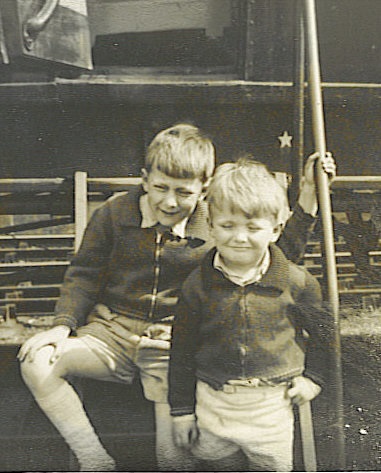
My love of steam locomotives – but more importantly, my lifetime sense of mourning for all those branch lines lost to Marples and Beeching and to the ensuing Labour government – grew out of a succession of family Easter holidays spent in a camping coach at East Budleigh station in east Devon in the early 1960s. The branch line ran from Sidmouth Junction down to Budleigh Salterton on the coast, and on to Exmouth. The stations it passed through on the way were Ottery St Mary, Tipton St John’s (where you could change for the Sidmouth branch), Newton Poppleford, and East Budleigh (for Otterton and Ladram Bay). I’ve always thought that those station names sound like they should be in a poem by Sir John Betjeman.
My father had a job on the railways, as had his father before him, and that’s why he knew about camping coaches. In addition, before the war, his family had often taken their holidays at Exmouth. I think I fell in love with East Budleigh station the day we first arrived there, when I would been aged nine. That first year we came down there by train, and I remember, but only vaguely, changing at Sidmouth Junction. There to greet us was East Budleigh’s friendly stationmaster, who was proud of his immaculate flowerbeds. He had time to tend them, and to win the region’s best-kept station award on more than one occasion.
To my nine-year-old eyes, the branch line was like a well-run train set. A tank engine pulling or pushing two coaches came along, and returned two hours later, as I remember. If we were in the camping coach at the time we always waved to the driver and the fireman, and they always waved back. If there were passengers, we waved to them, too. Usually there were a few. From the coach we looked across a field to the dark, swirling river Otter hurrying down to the sea. Each spring there were lambs in the field. One year after a bad winter – almost certainly 1963 – the river swelled with melted snow and broke its banks, and engulfed the field. Many lambs drowned or died from cold. On the far bank of the river there were tall trees, their upper branches studded with the nests of rooks. The air was full of their noise, and sometimes the sound of a shotgun in the distance.
And the fate of the line? Best to quote these authoritative and poignant words from a booklet by Colin G Maggs about the Sidmouth and Budleigh Salterton branches, one of a series published by the Oakwood Press (1996): “The line saw a good volume of traffic. In 1951 8,133 tickets were issued, rising to approximately 28,000 in 1962, but following this success, British Railways changed train timings with the results that figures dropped by half. In 1965 about 145 tickets were issued daily in summer and a mere 16 in winter. The first public notices of withdrawal were published in August 1964, the Ministry of Transport announcing the following year that closure would not take place until additional bus services had been authorised. The Devon General Omnibus & Touring Company Ltd agreed in February 1967 to operate extra buses and final closure notices were issued that month, train services being withdrawn on 6th March 1967.”
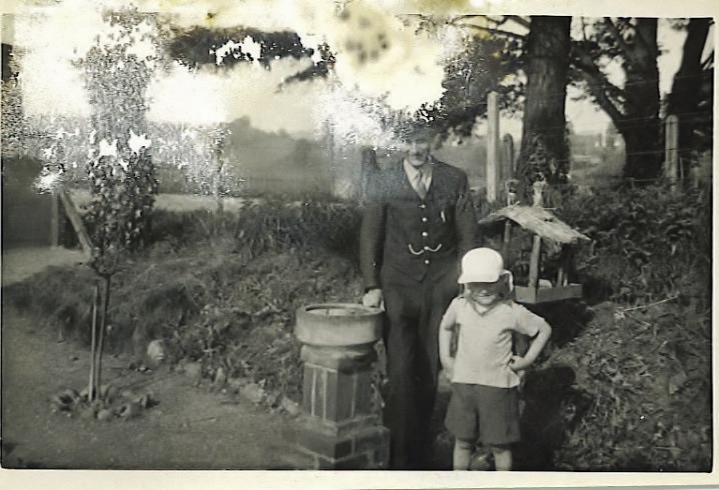
I returned to East Budleigh station in the mid-1970s with my future wife, and found it to be in a picturesque state of decay. In 1987 I was back again with my mother, and two small children, taking another photo, this time in front of the station yard gates. The station building was now a renovated private residence, as it has remained. It now even has its own miniature railway, which is
occasionally opened to the public. You can find much more information about East Budleigh station’s after-life here http://disused-stations.org.uk/e/east_budleigh/index.shtml
The old Ottery St Mary station building is now a youth club, according to Wikipedia, and the rest of the site an industrial estate http://disused-stations.org.uk/o/ottery_st_mary/index.shtml. Tipton St John’s station building survives as a private residence, along with part of one of the platforms http://disused-stations.org.uk/t/tipton_st_johns/index.shtml. No trace of the station at Newton Poppleford remains http://disused-stations.org.uk/n/newton_poppleford/index.shtml, while new housing stands on the site of the station at Budleigh Salterton http://disused-stations.org.uk/b/budleigh_salterton/index.shtml.
In the absence of a poem by Betjeman himself, I have written one, titled ‘The Old Branch Line’, which you can find in my poetry pamphlet collection, Trainspotters, published in 2015. There is also a more well-known poem about the line by Patricia Beer, ‘The Branch Line’, which turns up in railway anthologies, and was written to mark the last train in 1967. It includes these words: “The villages that gave / The stations their names / Were always out of sight, / Behind a hill, up a lane”. How true! Beer, who died in 1999, spent her later life in the valley of the river Otter, that the line ran through. Beavers have been introduced to the Otter, which joins the sea at Budleigh Salterton.
I do have other memories of west country holidays in the 1960s involving steam. The principal one is of boarding the Atlantic Coast Express at Surbiton station, and travelling down to north Devon, for a holiday at Appledore. A day trip that only went as far as Wool in Dorset, with me hanging out of windows a lot as the loco went round bends. But it is East Budleigh that is so close to my heart, and will always remain so.
by Greg Freeman
Over The Alps
Joe Jolliffee’s story below is about a journey being made purely to travel on steam-hauled trains before they finished. Because of engineering works to electrify the main line some trains were being diverted over the Mid-Hants (Watercress) line. The ‘pilot men’ were needed to assist the locomen over what was an unfamiliar route for them. Winchester Junction refers to the junction of that name where the Mid-Hants diverged from the main line and was not a station. 34008, 34023 and 35012 are all Bulleid ‘Pacific’ locomotives.
It was probably one of the first diversions that I heard of, so several of us did it for new steam track. Possibly inspired by hearing the route described as “over the alps”. I wasn’t expecting the gradient/climb to be that taxing. It was the night of 6th November 1965, 34023 stalled on Medstead bank for at least an hour whilst working 22.35 Waterloo-Bournemouth. Eventually it was decided that 34008,which was working the following 23.35 Waterloo-Weymouth, would assist in the rear. Effectively this was two trains going up as one with two locos. I cant remember this ever happening in any other of my steam journeys. They went up successfully (34008 was a good-un). Continuing the drama we were intending to catch the Up mails next (22.13 ex Weymouth) which we were expecting to miss due late running, however the pilot men went through to Winchester station rather than Winchester Jn, so with a quick scamper under the subway we made it onto the train (with 35012 at the head) to the consternation of station staff. The rest of the night went “normally”. 35012 had no trouble on the return.
By Joe Jolliffee
You can obtain a copy of the poetry pamphlet Trainspotters, which contains a number of other poems about railways, by emailing the author, Greg Freeman, at gregfreem62@gmail.com.

