


Bristol spotters Patrick O’Brien and friends pose on a loco at St. Phillips Marsh engine sheds 13th April 1964. Photo by David Nicholas.
A Post-War Subculture
There have been railway enthusiasts since the earliest days of railways. Certainly by the end of the nineteenth century books and magazines about railways and locomotives were being published and they proliferated during the next century. The idea of recording the numbers and names of locomotives also seems to stretch back into the Victorian era.
But a boom in ‘locospotting’, as it came to be known, happened after The Second World War. A combination of factors was responsible. People had some leisure time again and young people needed cheap past-times and hobbies. Information about locomotives began to be much more widely available through published materials. Lists of locomotives were available in the ABC guides published by Ian Allan from 1942. Ian Allan also published their ‘Locoshed Book’ which listed the hundreds of locomotive depots and their codes followed by listing the tens of thousands of locomotives next to the code of their home depots.
Although loco-spotting cut across social class and age it was certainly something of a youth subculture in the post war years. Unlike other subcultures and contrary to popular belief it had no dress code. Spotters wore the fashions of the day. What spotting did have was its own language, words and expressions sometimes originating from railway workers slang, but often created by spotters themselves. There was a degree of panic in the press with ‘trainspotting’ being labelled as a new form of hooliganism in some quarters. In one infamous incident in the 1940s, police were called to break up ‘disturbances’ when a large number of spotters in a field near Tamworth were vying for the best positions. Extra police were drafted in at weekends or bank holidays at some major stations to ensure that everything remained orderly at the platform ends.
In 1947 R.S. Grimsley published a book called the ‘British Locomotive Shed Directory’. This gave detailed directions of how to get to every locomotive shed and works on the national railway system followed later by Ian Allan’s own version.
The importance of locomotive sheds and locomotive works in the story cannot be underestimated. While many spotters congregated around large stations or vantage points on main lines the most attractive place to find large numbers of locomotives and also the less often seen ones were the sheds and works which maintained, repaired and stored them. But unlike a local bridge or a railway station these places were not generally open to the public.
A considerable number of loco-spotting clubs and societies were set up which organised visits to engine sheds and works on a regular basis. The ‘shed tour’ was born. This involved getting on a coach and driving to as many engine sheds as could be got to in a day or a weekend. A club would usually organise permits to visit each depot but this was certainly not always the case. More adventurous spotters spent their time individually or with a couple of mates simply ‘bunking’ or ‘doing’ sheds, terms for visiting unofficially, trying to ‘get round’ before they were caught and evicted. Different sheds gained reputations for being easy or hard to ‘bunk’.
By the 1960s it became clear that steam traction was going to finish towards the end of the decade. Steam locomotive classes were disappearing at an alarming rate and for many spotters it was a race to see as much as they could in the remaining years until steam finished on British Railways in August 1968. It was also a period when souvenir hunting became prevalent. The plates showing locomotive numbers or their shed codes were often missing. There is a huge amount of railway memorabilia available today from this period. Much of this would have been acquired officially but certainly an unknown percentage was not. Many spotters returned from shed or works visits with a duffel bag containing a lump of metal or two. And many a grimy steam locomotive rumbled past a locospotter with no means of identification or its number hurriedly chalked on where the missing number plate had once been.
The following memories will hopefully convey some of the atmosphere of this unique period of the history of railway enthusiasm. They are varied and include anecdotes, poems and photographs. They hopefully have a broad appeal but those which have jargon or details that you would need to be a former locospotter to fully appreciate tend to be at the end.
If you would like to make a contribution please contact Keith by email;
kchambers@hotmail.co.uk
Sunderland Shed Bash
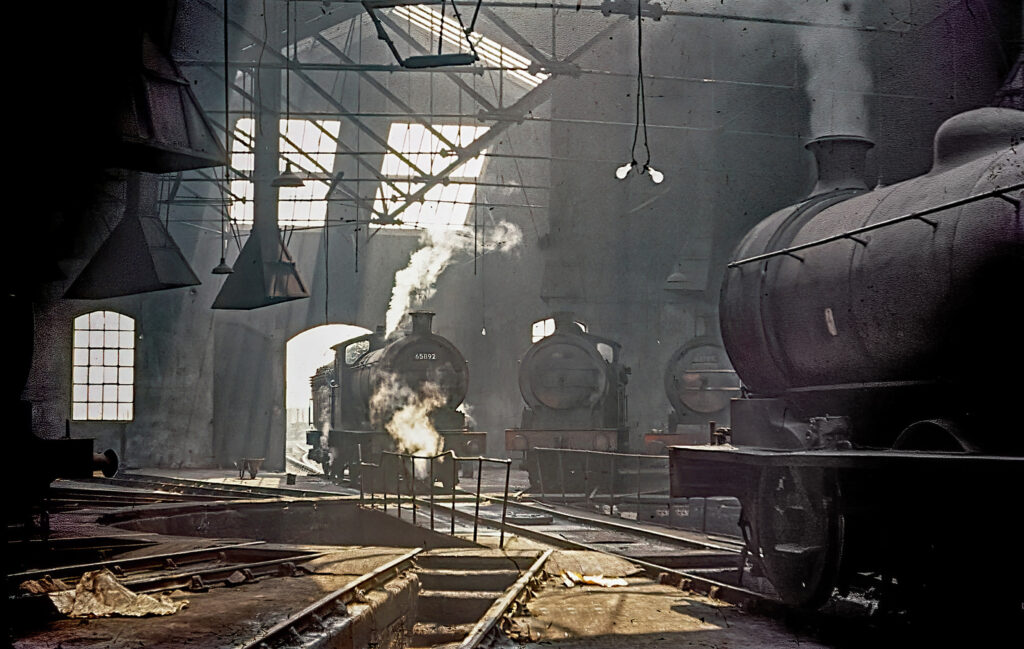
Phil’s photo conveys the atmosphere of a British Railways engine shed wonderfully, visually at least. Those who didn’t experience them will have to imagine the smells and sounds which were all part of the experience plus the excitement of being somewhere illicitly and that it would soon disappear forever.
A Brummie Spotter in the 1950s
My father worked at HP Sauce in Birmingham. On Saturdays he would take me into the city with him to buy vegetables at the markets around The Bullring. We would travel by train so that even from a young age I became interested in the locomotives and trains that I saw on those journeys especially as we passed the big engine sheds at Tyseley. Once he took me to visit an engine shed which I think may have been Aston as that was close to the HP Sauce factory. He was a good amateur photographer and had arranged the visit to take photographs. He encouraged my interest by buying me some Ian Allan ABCs.
By the time I was seven or eight years old I used to travel into Birmingham by bus or train. The train was more expensive so I generally didn’t pay but dodged any ticket inspectors. I just didn’t have the money to pay. I would usually spend time at Snow Hill station at the end of a long platform where you could see all the trains passing through. We would buy platform tickets if we had to but often found our way on without them. Then we would catch trains locally and see how far we could get without tickets. We would be out all day. Then sometimes we would bunk local engine sheds. Saltley shed on the Midland Region was difficult because there was only one entrance and we were often grabbed and thrown out quite literally before we got round the whole shed, the staff saying that it was not safe for us to be there. Other spotters in the shed would warn us if any staff were doing a round looking for intruders.
Tyseley shed on the Western Region was easier to bunk and the shed staff were friendlier. We did not go in the official entrance but climbed over a chain link fence. The holes were just about big enough to accommodate our young feet. On the other side was a bank which we slid down and then we were in. Tyseley was an interesting shed because as well as servicing locos there was a repair shop there and often we would see locos from outside the area which were not regular visitors to Birmingham. That bank was too steep to climb back up so we would leave the shed by the main entrance. We would still prefer not to be seen and so our usual strategy was to visit the shed at around lunchtime when there was only one person at the gate. We would wait for him to be distracted by something such as a lorry coming in and then try and exit unnoticed.
When we were a bit older we would travel further afield. Tamworth was a well-known place for lineside spotting as two main lines crossed there and you could position yourself on public paths. There were always twenty or thirty people there. The local farmers didn’t like us being there as inevitably some people would spill over onto their fields and trample crops.
I did spotting for about eight or nine years. I hated school and by the time I was about fourteen was only attending some of the time and working every other hour I could to earn money to follow my other newer interest which was motor racing. This left me with no time to do any spotting. Steam locomotives were visceral. It felt as though they were alive, very much like the racing cars of the period which I had begun to watch in action regularly.
Graham Carter

JULIE CHRISTIE
by Greg Freeman
The train left St Pancras at half-eleven
some time in 1965, crawled through the night,
while I dreamed of the Beatles, Julie Christie;
sidled into Leeds Central station
with the milk just after dawn.
We piled onto the coach to tour
doomed engine sheds: Bradford Low Moor,
Normanton, Huddersfield, Wakefield,
and many, many more. The jack the lads
with long hair and Chelsea boots
jumping back in the coach with lamps,
signs, looted souvenirs. The mystery tour
twisted and turned, hurdled
hills of a country pockmarked
with winding gear. Made me feel sick,
wonder what I was doing there.
I recall lines of grimy locos,
uncared-for beasts caked with dirt,
extras in a black and white film,
waiting for the knacker’s yard at Barry.
Years later found myself
supping Tetleys at the Central Station pub,
thinking myself a northern stalwart,
overlooking the derelict acres
where my train had arrived
with all the other Billy Liars
from next door’s Salvation Army hostel
still pondering Courtenay’s cowardice,
Julie’s expression from the carriage,
her sad, platform goodbye.
Greg Freeman is a former newspaper sub-editor and current news editor for the poetry website Write out Loud. His debut collection of his own poems is entitled Trainspotters and is published by Indigo Dreams Publishing Ltd.

An Alternative to Aimlessly Hanging Around
Born in the early fifties, living in various parts of London and the home counties my father instilled in me interests that were similar to his and probably typical of many children growing up at the time. Those interests included natural history and a love of steam locomotives. As far as the latter was concerned I was born just in time to see the last decade of steam operation on British Railways (the nationalised industry) and witnessed its decline with sadness and a fascination bordering on obsession. Just as I leafed through the publications describing the wide range of locomotives still in daily service the variety and number were declining rapidly. The Railway Magazine, a publication that my father read, regularly had a feature called “Class Extinct” which described yet another locomotive type that I would now never get to see. I don’t especially like the term trainspotter but the day I became one was in the school summer break in 1962. Dad was at work and my mum probably frustrated that I seemed to be hanging around aimlessly thrust one of the Ian Allan ABCs in my hand and said “Why don’t you go and do some trainspotting?” So I did and she probably regretted that moment ever after. I was already familiar with many locomotive classes and their origins from visits that my father took me on to various railway locations. But after my first day of recording what I saw and meeting others doing the same from a local railway bridge I was hooked. Taking down the numbers was simply a framework to build my interest around.
For the next few years much of my time was spent pursuing this pastime. It was still a time when children seemed to have more freedom to roam than now. I would disappear in the morning and reappear in the evening. My parents knew who I was with but often had no idea how far I had travelled and I often didn’t tell them.
Why was it so addictive? Firstly steam locomotives are very sensory things. They are a mixture of form, movement, smells and noise. People often describe them as seeming to be alive. Equally evocative were the places where we saw them. Big old Victorian stations were very atmospheric and were once described by the writer Christian Wolmar as ‘Cathedrals of Steam’ and anyone who has experienced a large terminus full of steam locomotives will understand why. I think the term equally describes some of the big engine sheds. What wonderfully atmospheric places they were, especially when they had become a little dilapidated, with light streaming through onto the steam shrouded occupants.
In his book about spotting Julian Holland wrote: “the writing down of numbers might seem very boring to the uninitiated, to me it was much more than just that. In pursuit of my hobby I travelled far and wide from my home town of Gloucester, usually with likeminded school chums, visiting obscure and often remote railway stations and engine sheds – every trip was an adventure and my knowledge of the geography of our country has stood me in good stead ever since”. (1)
My own spotting began when for many it was ending. By 1963 some old hands were beginning to feel that there was so little left that the hobby was no longer worth persuing. One of the more well known clubs The Home Counties Railfan’s Club which had for years organised railtours and visits called it a day in 1963 for that reason. For people like myself it was Hobson’s choice and the reality was that there were still thousands of steam locomotives operating and still scores of engine sheds to visit.
A major part was the unexpected. A bit like observing wildlife you never could be absolutely certain what you were going to see especially when most information we had was weeks or months out of date. And my favourite places were engine sheds. Following a couple of official visits to railway works with my old man my ten year old self began to hear the language of the more determined spotters. You could ‘bunk’ engine sheds but you weren’t supposed to and you avoided being caught. There was a folklore around it about avoiding authority, lucky escapes, friendly locomen, sleeping rough, back ways into engine sheds, finding unexpected locos and so on. I absorbed it all and wanted to be part of it. I wanted my own stories to tell. The first shed I ‘bunked’ was with my dad. We were visiting my grandmother and went to Watford Junction station. The entrance to the engine shed there was literally off the end of one of the platforms. We quickly and nervously walked in wrote down what we saw and quickly went out again. Soon afterwards I was with a couple of mates inside the engine sheds at Basingstoke. I can remember the feeling of excitement even now of being inside an engine shed unofficially enjoying all its sights, sounds and smells. We surrepticiously made our way round fearful of being caught. And once we left that feeling of relief and total satisfaction. I had made it. I had bunked an engine shed and left with my prize, that list of numbers.
Then followed hectic years of seeing as much as possible before it all inevitably disappeared forever. The various clubs that ran railtours enabled me and my mates to do this cheaply. By late 1963 I had discovered shed tours. Basically this meant driving around in a coach all day or all weekend ‘going round’ as many sheds and works as possible. This could be a dozen or more in one day depending on the area. It was a cheap and effective way of seeing a lot of locos. In between those trips we made our own visits travelling further as we got older and had a little more cash. A Saturday or Sunday would be spent travelling to a shed or two by train, bus or bike all bunked unofficially of course. The clubs would arrange permits or not! I was a member of the Worcester Locomotive Society. (I lived nowhere near Worcester but they ran good trips.) They usually organised permits for shed visits. Another club I belonged to generally didn’t. That was the Greater London Railfan’s Club. Often it was a bit of a mixture as described in this account of an organised railtour visiting sheds in the Bristol area in March 1963. There were three big engine sheds in the city and permission had been obtained to visit two but not the third, Bath Road, which had recently ‘closed to steam’ but was a working diesel depot. However there were still stored steam locomotives there. Chris Lewis recounted the following published in the magazine Bulletin.
“Permission to visit Bath Road had been refused but many enthusiasts decided to visit anyway. The police were called and those that were in the shed area quickly ran back along the main line to Temple Meads’ platforms.” (2)
My own local area saw the last steam hauled express passenger services in the country on the mainline from Waterloo. Steam ended on the line on Sunday 9th July 1967 and I found the event so sad that I avoided it completely and said my goodbyes to Southern Region steam the weekend before. By the time I was 15 it was all but over. Just a handful of steam sheds survived in the north west of England until August 1968.
References
- p6 Railway Top Spots by Julian Holland (David & Charles 2012)
2. p47 Bulletin (journal of the Locomotive Club of Great Britain) volume 73 no. 2
Keith Chambers

A Surrey Spotter
I started spotting around 1963 when I was about ten. A friend got me into it. We would go and watch from the lineside, usually a bridge somewhere close to where we lived on the main line from Waterloo between Woking and Brookwood. Most passenger trains were still steam hauled then even the stopping services. A few times my dad drove me and my friend to Slough. I am not sure why. I think he had some work connection there. Anyway it was on a different line so the chance to see less familiar locos. Slough had an engine shed which was very easy to get into and that was what got me into bunking engine sheds. It was then that I realised that engine sheds were places to see more locos and often more unusual ones. Not all sheds were so easy to get round. For the next few years I went round lots of sheds either officially with an organised shed tour or unofficially. Different railway staff had different attitudes towards spotters. Once I was with an organised tour of engine sheds in the west country. This was with the Greater London Railfan’s Club. They didn’t often bother with permits and just used to bunk sheds. We arrived at Exmouth Junction shed which had closed to steam but there were still a number of steam locos in store there. Approaching the shed we suddenly met the foreman who told us to “get out!” We did, waited around a corner for a while then made our way back into the shed and split up. I had gone up and down a few rows of diesel locos then went into the part where the steam locos were. Then I met the foreman again.
“I told you to get out!” he said and grabbed my ear and dragged me out of the shed. It was frustrating because I didn’t get to see all the steam locos there.
Another time I travelled overnight to Carlisle and then walked to the engine sheds at Kingmoor which was a long walk and arrived at the shed when it was still dark. I had a torch with me so that I could read the loco numbers. I had just got in when a driver stopped me.
“Have you got a spanner with you? Are you nicking numberplates?”
I said that I wasn’t and just wanted to see what locos were there.
“Okay” he said “round you go.”
It was the day it closed to steam but there were still nearly seventy steam locos on shed plus loads of diesels. On the way out the foreman caught me and threw me out. That was the difference. Usually drivers didn’t bother but if the foreman caught you he would kick you out.
On another occasion I was going round Backworth shed in Northumberland with some friends. The locos there were all tank engines which hauled coal from local collieries. A driver asked us if we wanted a footplate ride. Of course we said yes. We ended up going on the loco to Fenwick Colliery with a train of empty wagons and then after a bit of shunting came back with loaded wagons.
Steam on British Railways ended in 1968 but that wasn’t the end of steam. Northern Ireland Railways and London Transport were still using steam locomotives. The National Coal Board still used hundreds of steam locomotives on its private lines and so did other industries. (Backworth was an N.C.B. shed.) Also there was still steam in some parts of Europe and beyond. So I carried on bunking engine sheds and seeing steam locomotives for years after.
Ian Gosden


TRAINSPOTTING
by John Coopey
I journeyed but once from the old Hucknall Central,
A station now gone on the GCR line;
Its imprint on memory, though, quite monumental
Made mystically precious by passage of time.
The floors and the stairways so basically timbered;
They echoed our footsteps; we ran without stop;
We carried Ian Allans with sequences numbered
And jotters and pens and a bottle of pop.
Then pushing and jostling embarking the carriage
To get a compartment that’s all to ourselves;
Three heads through a window as best we could manage
Then clambering onto the net luggage shelves.
The city of Nottingham our destination,
A trainspotting Mecca of juvenile joys;
The dark and foreboding Victoria Station
Almost a cathedral to 12 year old boys.
Victorian workmanship, proud and expressive,
And hewn in a cutting of hard sandstone rock;
Its length and its curvature doubly impressive
The calm reassurance of Smith’s platform clock.
And then the reward for our day’s expedition –
The sweet expectation a rumour would bring;
The racing and shouts that confirmed the suspicion –
The spot of occasional Castle or King.
Evading the watch of the slow railway bobbies
Patrolling at Colwick or Annesley shed;
How to explain this most pointless of hobbies
Which only resides in the heart, not the head?
The pain of nostalgia is real and not mental;
Victoria Centre’s a new shopping mall
And Lidl replaces the old Hucknall Central;
The march of modernity’s taken its toll.
Spotters’ Gallery 1


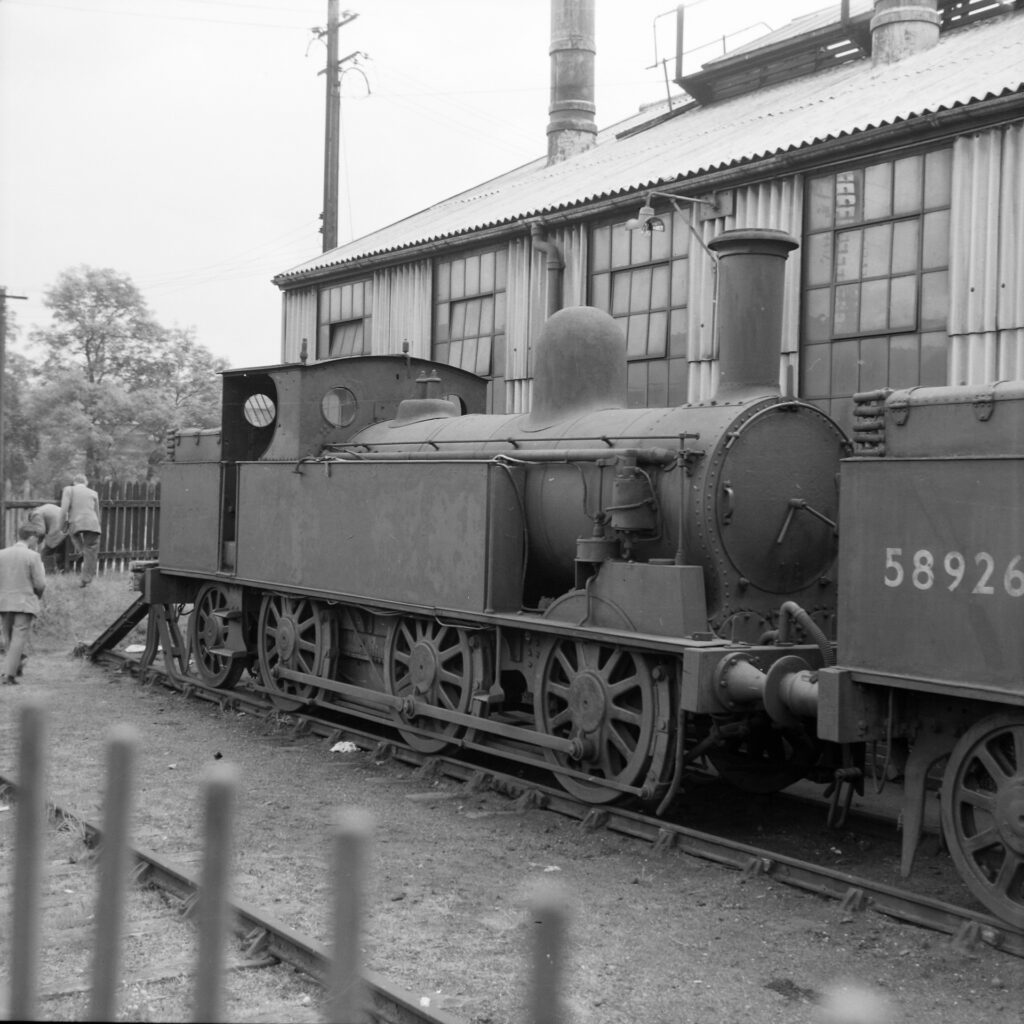
A Merseyside Spotter
I first became interested in trainspotting when a friend of mine moved away just after the Second World War. Being at a loose end the idea appealed to me, don’t ask me why.
So I started my spotting at Penny Lane Bridge between Sefton Park and Mossley Hill stations, Liverpool. I used to spend the afternoon during school holidays there, home for tea then back until about 9 o’clock. There were other lads at the same location and I was first shown an Ian Allan ABC.
Some years later I joined the Locomotive Club of Great Britain which was London based. On one memorable occasion I went on a trip with them around sheds in the Swansea area. I arrived at Swansea station in the early hours of Sunday morning waiting for the rest of the group to arrive from London. The coach driver appeared who knew one of the railwaymen who asked him why he was there so early, to which he replied that some idiots were going round engine sheds! Another trip with this club to sheds in the north east entailed an overnight stay in the waiting room on York station and meeting up in the morning.
You could write to the various railway authorities for permits to visit sheds and works and arrange your own trips. The Eastern Region were quite strict about permits but if you worked for B.R. and could persuade your boss to write on your behalf they would grant permission.
The Shed Directory was very helpful covering all B.R. sheds with directions and bus or tram details to find your way to any shed you wanted to visit. If visiting on a Sunday a lot of premises were easy to bunk around with the added advantage that lots of locomotives were stabled for the weekend. One Sunday my friend Graham and I were touring the Leeds sheds and did a shed bash around Ardsley shed. We had finished and left and were standing at a bus stop when a British Transport policeman appeared shouting at us. We were very fortunate because a bus appeared enabling us to escape.
Peter Hanson


Whiling away the Night
Sometime in early 1968 I was travelling with a small group of fellow spotters to the northwest of England for an organised shed tour of the last remaining steam sheds on British Railways. We were picking the tour up in Birmingham early on a Saturday morning and as we were travelling from the southeast the only way of meeting on time was to get the last train from Euston on the Friday night. This meant a four hour wait on Birmingham New Street station in the early hours. Maybe we had intended to try and sleep rough somewhere on the station but in the event there was nowhere comfortable to do this and so we decided we had plenty of time to visit at least a couple of engine sheds in the area. We weren’t expecting any steam locos as steam had finished in the area by then but diesels were mildly interesting and better than doing nothing. The four of us found a taxi and the driver found his way to Saltley shed for us. We paid but asked him to wait for us. “Fifteen minutes” he said “then I’m leaving”. Engine sheds at night were usually easier to bunk under the cover of darkness but Saltley was very well lit by a number of large floodlights. We hadn’t got far before a voice through a loudspeaker said repeatedly “Can the locospotters please leave the engine sheds immediately”. It’s disconcerting hearing a voice coming from all directions and no human to respond to. Somewhat confused we did as we were told and left. Our taxi was still there so we asked him to get us to Tyseley and endeavoured to bunk the shed there. There were a few diesels but we were more interested in the old steam shed which when we entered was pitch dark inside and we took a while to get used to the light. We soaked up the atmosphere of the old depot and almost had to feel our way around it. Steam sheds were hazardous at the best of times but somehow we managed not to fall in any of the inspection pits that abounded in these places. Then to our surprise we discovered that the large dark shadow to one side was actually a steam locomotive. We collected some paper and lit it so that we could make out the number. I felt very satisfied. I had never bunked Tyseley before and so to do so and find a steam loco on shed was unexpected as the shed had closed to steam about 18 months earlier. (The loco was scrapped a few months later.) In our enthusiasm to enjoy this doomed environment we had well overshot our fifteen minutes but our taxi driver had waited and we arrived back at New Street well before time.
Colin Chambers

Over The Laundry Wall
Tales of a Northampton Spotter
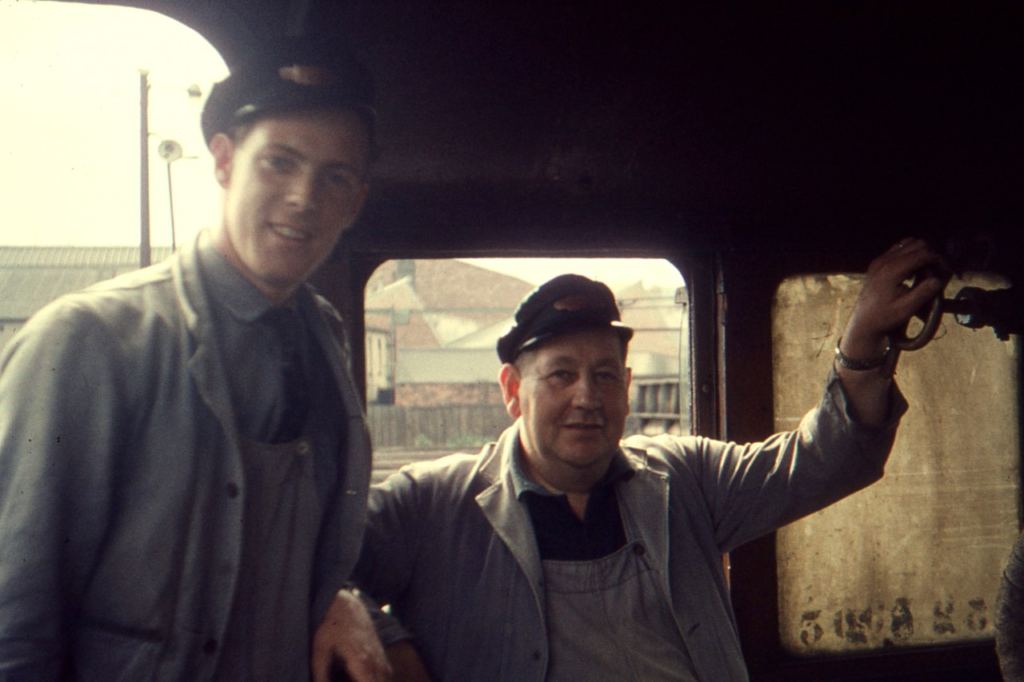
It all started back when I was six years old in 1954. My dad bought me an Ian Allan Locospotters’ book as I always loved to see trains and wanted to know more. So, on one of our regular trips to Leighton Buzzard to see relations I crept away to the lineside and tried to do some spotting. Little did I know that my parents had bought me the Eastern region book and I was living on the London Midland Region, so none of the numbers was in my book. This was soon corrected and now I had a great excuse not to spend boring afternoons with my aunt and uncle. It wasn’t too long afterwards that a Welsh lad across the road named Evan announced that he was going trainspotting at Blisworth on his own. This was a big deal, as I lived at Northampton and it was on a loop line. The main express services bypassed Northampton and went through Blisworth five miles away. It may seem astonishing today, but Evan (aged seven) and me (aged six) were allowed to catch a bus to the railway station and then a train to Blisworth. We joined a whole load of other lads in a field by the main line and caught the 4.30 push-pull train back to Northampton. These days our parents would probably be arrested for neglect. I haven’t got my first 1955 spotters’ book, but I do have the 1956 edition, which is very scruffy. It’s a book that has lived a life.
Northampton and Blisworth had to do for a while, but then we found that if we caught a train eastwards we could visit a completely different main line at Wellingborough, which had services from faraway places like Sheffield, Derby and Nottingham. This was the first time I ever tried to visit an engine shed. We just strolled in, walked around and quietly walked out. All of a sudden Wellingborough became our new focus simply because I loved the atmosphere of an engine shed, and Wellingborough was packed with big freight locomotives.
If Wellingborough had a shed, I said to my dad, did we have one at Northampton? One Sunday lunch time he drove me to Northampton shed and we wandered around. Not as busy as Wellingborough, but here I met some engines which were to be favourites for many years up to the end of steam. With Leighton Buzzard (which had a tiny shed housing just three engines), Blisworth and Wellingborough, I had a nice little range of places to visit. But heck, I was now ten years old and it was time to spread my wings. This started when we visited an ancient auntie living at Sandy where the East Coast Main Line ran through. Amazing! All those fine Eastern Region locomotives named after racehorses and birds were on view. Not only that, but my dad suggested on one visit that instead of travelling home by car, I might like to go by train on my own. So, I caught a train from Sandy to Bletchley and another to Northampton station and then a bus home. Brilliant!
Shortly after this a long -ost cousin from America named Andrew who was my age was staying with yet more relations, this time at Hitchin. ‘John,’ said this lad. ‘I wanna see the Mallard.’ Well, the chances of going to Hitchin station on a Sunday afternoon at four o’clock and seeing Mallard were highly remote, even though it regularly passed through Hitchin station. Dad said we could go for just an hour and then he would
pick us up. Well, we didn’t see Mallard, but we did see its sister Guillemot and I think Andrew was satisfied. He went back to the USA and sadly I have not seen him since.
We now started to visit Sandy and Peterborough regularly and were getting quite a useful spread of numbers in our books. Back in those days we used to go out transpotting in our school clothes. It was simply what you did and it was the early 1960s before I owned anything you might call casual to wear. A new friend suggested a more ambitious trip. ‘Let’s go to London and go round all the stations.’ This seemed a super idea and after a bit of negotiation with parents it was agreed we could go, but that we had to get the 6.15 train back to Northampton and were to phone if we missed it. So started a series of trips by two 12-year olds to London, visiting St Pancras, Kings Cross, Liverpool Street, Victoria, Waterloo and Paddington in one busy day. Only once did we have a problem. We went to the loo at Euston after arriving and were walking the short distance to St Pancras when I noticed a chap who had been in the toilet at Euston following us. We were definitely uneasy about this. Amazingly a Bobby was walking towards us, so I walked up to him and said, ‘That man has been following us since we used the toilet at Euston.’ I pointed at the man. The policeman replied: ‘Just carry on your journey and don’t look back.’ We did just that and happily the man disappeared. We never had any other problems.
Soon after this we started visiting London engine sheds, rather than just stations. This meant getting out to Willesden by train to visit both Willesden and Old Oak Common, two big sheds next to each other. We were never asked to leave either, but we behaved ourselves and tried to be sensible. I do recall seeing the pride of the Great Western, a King class locomotive and marvelling at the polished green paint and gleaming brass.
On one of these trips, it was decided we should try to visit the big London shed of the Southern Region at Nine Elms. This was like a fortress, but we were getting older and bolder. At the main entrance on the left was a little hut, patrolled by some kind of official, plus a railway policeman. ‘No trouble’, I said to the waiting group of spotters, drooling over all the engines they could only see in the distance. I ducked down and walked past the window and then bobbed up again, walking discreetly onwards. Ten seconds later I was outside the gate again after a very firm official departure. Oh well …
So we went spotting at Clapham Junction, where there was a good view from a park across all the busy tracks. A lad there named Digby whom we met heard my story of failure at Nine Elms and had a solution. It was a winter Saturday and got dark early. Once dusk fell, he led us back to Nine Elms by bus, then around endless side streets by the shed. At one of them he stopped by a building which was a commercial laundry. He pushed open a gate and ahead of us was a wall, over which we clambered to visit Nine Elms for just one magical occasion. Once inside, we were not challenged by any railwaymen. Digby boasted he could bunk (verb: to enter illicitly) any shed in the UK. After my Nine Elms exploits, I believed him.
Of course, you could be a bit of a wimp and write off to British Railways for a permit to visit sheds. This stated that you had to be a properly organised society and that visits had to be of ten persons or more. No problem. I immediately formed the Northampton Railway Society of which I was the only member.
Clutching a permit and with just one friend, we set off to visit March in East Anglia, a shed that made Fort Knox as welcoming as a Women’s Bright Hour. Even locals said they never managed to penetrate its officious confines. Waving my permit at a bunch of lads on March station, I invited them all to be instant members of Northampton Railway Society and ten of us trooped off to have an official visit to March shed. Job done.
This trick was repeated at Crewe North, Crewe South and Crewe Works on one momentous day.
Occasionally people would be very friendly – usually railwaymen. While I was asked to leave both Vauxhall and Thornaby stations just because I had a spotters’ book (I was actually waiting for a train at both places and had to creep back in just before my service arrived) sometimes you were treated like a guest. While on holiday in Bournemouth I started a daily visit to Bournemouth West station, long since closed, and setting foot on its platforms for the first time, was encouraged by a porter to go and chat to the driver of a streamlined Pacific waiting to leave for Waterloo. I did so and was immediately invited on to the footplate and shown the miraculous foot-operated firehole door and all the other unusual features of the engine. Not bad.
At Blisworth, many years earlier, I was also invited on to the footplate of a wheezy old London and North Western 0-8-0 freight engine, together with three or four other lads. The driver took us one hundred metres along a siding and back. My last ride on a BR steam engine was the day Northampton shed closed. A driver invited a friend and myself on to the footplate of the last engine to use the turntable and I sent him colour photos of both driver and fireman as a memento. (I was reunited with the fireman a few years ago – happily he remembered us and still had his copy of the photo).
Occasionally we went on coach trips, where you set off at some hideous hour and then drove around half the countryside visiting ten sheds, getting home late at night. These were not very interesting – I liked time to spend looking at engines and savouring the railway atmosphere. Going around Swindon Works in 20 minutes just taking engine numbers was not what it was all about for me.
By the end of 1964, I decided collecting engine numbers was a bit passé, so, 1964 is my last spotters’ book. After that I took photos yet spent just as much time on the railways. When I think back to those early days, we were serial trespassers, but never really caused any harm. I once wanted a sign from a bridge over a railway line that had closed many years earlier. I wrote to the station manager at Northampton to ask if I could remove it. I also wrote to ask if I could take photos at a remote junction and he sent me a nice letter saying yes, but take care. From those early years I have made friendships that have lasted until today. I also learned a strong sense of independence, a very detailed geography of the UK that has stood me in good stead and have written many articles on railways, plus nine books. All in all, I would say that those happy days were genuinely some of the best of my life
John Evans

Bunking London Sheds
In the mid 60’s, I was an enthusiastic member of The Railway Society at school. It was a very active club and there were regular meetings and various outings. I remember a visit to Barnes signal box, for instance. But the best of the lot was the day when about 20 or 30 boys were let loose in London to visit as many engine sheds as possible using Red Rover tickets. Before train spotting, my first love was collecting bus numbers. There were still trolley buses around when I started doing this and I was very familiar with Rover tickets which allowed unlimited travel for the whole day for just 2/6d. So, a day of clambering on and off buses, visiting engine sheds; utter bliss for a 12 or 13 year old me! I don’t remember any teachers being involved with The Railway Society. Certainly there wasn’t any adult on this adventure. Keeping us all safe were a few sixth formers who weren’t that more sensible than the rest of us. One glorious moment saw us on the correct bus but heading in the wrong direction. This became apparent when a bus coming the other way was displaying our destination on its indicator board. This resulted in a mass emergency evacuation of almost all the passengers on the top deck! We piled off, ran across the road and scrambled on to the other bus. Neither bus was at a stop, just crawling through the London traffic. This all happening in the wonderful days when buses had open platforms and if one left without you? Well, you still had a chance of catching it at the next traffic light.
And where did we go that day? Well, certainly Willesden, that was always a favourite and a good boost for the Midland Region section of the Combined Volume. Southern Region had Nine Elms, Old Oak Common was on the Western and perhaps we ventured up to Finsbury Park to see some Deltics. How do I remember all this? Well, all my old train books are directly behind me on the bookcase! When I’m gone and my kids are clearing up, I don’t fancy their chances.
John Manson
Spotters’ Gallery 2

A feature of locospotting by the 1960s was visiting scrapyards. By this time so many locomotives were being withdrawn that British Railways could not deal with them all and sent them off to various scrappers. Consequently for a few years spotters bunked scrapyards as well. This view is of Hayes Scrapyard at Bridgend on 18th June 1966 on a scrapyard tour organised by a London club. Spotters swarm around the yard. To the right is the B.R. main line which some of us are presumably using because it is easier to walk along! The centre loco is 45655 named Keith which I was very pleased to see for the first (and last) time. Copyright Keith Chambers
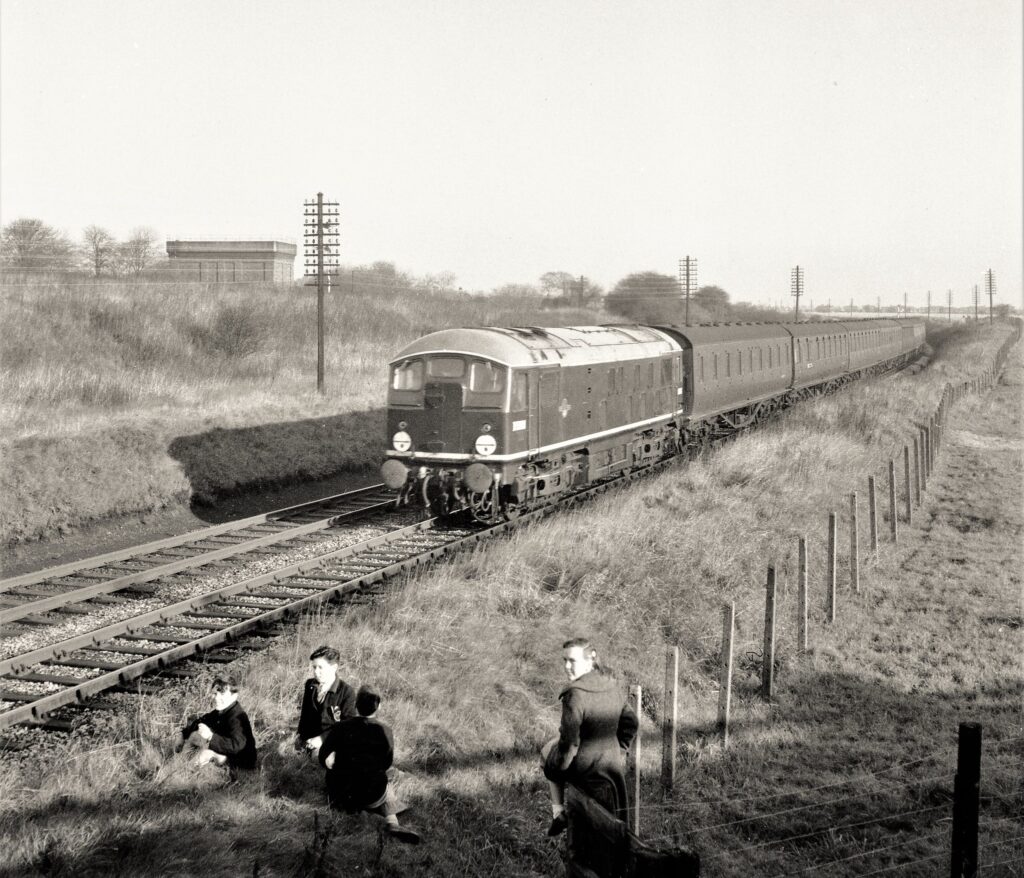
A Bristol Spotter
I first started seriously going to Temple Meads station in April 1961 and would go there most days in the Easter and Summer holidays that year and also on Saturdays. I made several friends there among the large group of spotters that frequented mainly Platform 4/5. I was introduced to the steam sheds at St Philips Marsh and Barrow Road and would frequently visit either on foot or on my bike. I lived close to Redland station on the Severn Beach line so often travelled to and from by train. In 1961 at the age of 13 I would have visited Swindon Works on a Wednesday when it was open to members of the public, as well as Gloucester, Exeter and London.
By April 1962 I would be visiting Temple Meads, Barrow Road and the Marsh on most days during the holidays and in the evening. I used to catch the 17.25 from Redland and return on the 19.05 back. It was during this year that I met David Nicholas and John Freeth with whom I am still in touch and see fairly regularly (but not at the moment). From April 1962 I kept fairly extensive records which continued until the end of steam in Bristol at the end of 1965. I have lost one notebook from June 9 1965 until early September. I created a website Bristol Steam 1964 in 2012, but that is no longer available as it needs to be revamped to cover all the years in Bristol 1961-65.
Up to 1965 I would visit other areas including Rugby, the London sheds, the Southern sheds at Salisbury and Eastleigh as well as visits to Birmingham. At the beginning of September 1965 I had a week’s railrover ticket for the whole of BR and slept on overnight trains while visiting sheds from Willesden to Aberdeen. The ticket cost £18 and I still have it. With the end of steam in Bristol at the end of 1965 I regularly visited sheds in Birmingham, Wolverhampton, Manchester and Liverpool and West Yorkshire as well as the scrapyards in South Wales and elsewhere. In July 1966 I went on a hitchiking fortnight around the country with John Freeth and covered sheds from Shrewsbury to Aberdeen. We had 102 lifts altogether, staying at Youth Hostels or hitchhiking through the night. We saw some of the last A4 workings in Scotland and the last 9F workings from Tyne Dock. Many of the photos taken are on my Flickr site. I was working in Old Windsor from April to July 1967 so regularly went to Waterloo and Nine Elms for the end of steam on the Southern. I travelled from Waterloo to Southampton on the last Friday with 34093 and back with 34013. I also went around Guildford and Basingstoke and took photos at both places.
In September 1967 I went to University at Leeds just as steam was finishing in West Yorkshire. I travelled on some of the last trains between Leeds and Bradford and frequently visited Normanton shed which was kept open to service locos from Carlisle and Manchester until the end of 1967. One passenger train was still steam hauled through Leeds the FO 17.37 Manchester to York, usually with a Kingmoor Britannia. In 1968 on August 1 I hitchhiked from Leeds to Carnforth and saw the last steam hauled service trains on the Sunday at Preston station with 45212.
Patrick O’Brien
Patrick co-authored a book “Steam around Bristol: the final years” with David Nicholas in 2016 published by Amberley.
Spotting in the 50’s
In the area of North Acton, you had the Great West mainline, which went from Acton down to Ealing Broadway off to all the stations to Bristol and elsewhere. Also up there, you had Old Oak engine sheds which were where all the old engines that went out of Paddington were brought to be serviced, to be coaled. It was a full round house. And then a little bit further away from that was Willesden which was a round house and sheds for Euston Station. I was shown where the holes in the fences were and where you could get in. You would hide your bike somewhere and walk in. Alright the shed men used to find you, but as long as you were being sensible and weren’t up to any horse play. They would just say “don’t muck about” and they would let you walk around the round houses. Walk around the big turntable in the middle, walk up and down inside. The guys that were servicing the engines, oiling them and those sorts of things would chat to you and let you climb on the footplate. In one sense, no health and safety but in another sense, you were being watched and you were being trusted as well. Occasionally you got chased off when you got a grumpy one. But by and large, as long as you weren’t mucking around and weren’t doing stupid things they, welcomed the interest. So, that was where I learnt to go and look at LMS engines and Great Western engines, steaming either out to all stations to Glasgow or all stations to Bristol and Cardiff.
Officially we were not allowed and there was an element of trepidation. You didn’t know they weren’t going to call the Railway Police. There were guards on these places in the early days, but a little bit later on you learnt to go and find someone and say “is it alright if I do this, I just want to go there, I just want to do this”. I couldn’t have been more than 9 at this point. They would say things like “oh alright, stay off the track”, “if there’s a moving engine make sure you stand well clear” or even “come and look at this”.
John Wood
Trainspotting Memories
In 1950, when I was twelve I was invited by my best friend to spend three weeks with him in the summer school holiday with relatives in Hatfield, about five miles from Doncaster. I think the idea of his parents was that I would keep him company while we visited his relatives all over Yorkshire. In fact most days we caught the bus into Doncaster and spent the day train spotting from the cattle dock there. I seem to remember that the place was awash with B1s though we did see a couple of GC Directors on Sheffield trains and pacifics most non-stop through the station. We went down from Kings Cross on the 10.10 to Leeds and my friend’s dad put us on the train and then went to get the number of our engine and that of The Flying Scotsman* on the adjoining platform. He inscribed the numbers in the condensation on the outside of our carriage window (60033 Seagull on our train and 60067 Ladas on the Scotsman). Engine-spotting by proxy doesn’t really count, but we could just about see the A3 if we craned our necks and of course we got a good eyeful of our blue A4 at Doncaster. I remember going to Sheffield one day by bus (we couldn’t afford train fares) and I saw my only GC Atlantic (nicknamed ‘Jersey Lilies’), 2909, from the top deck of the double-decker. We went to Sheffield Victoria and were refused entry at the barrier when the ticket collector saw we were train spotters. However, when he learned we were from London, he relented and let us through. All for what? One solitary B1 we’d seen at Doncaster! On another occasion we caught the bus to York, and were held at a level crossing and saw Thompson’s rebuild of the P2 2-8-2, ‘Cock o’ the North’ fly past with a northbound train of empty fish vans.Then we went to visit his Gran in the Cudworth area. Cedric, my friend, was very excited and we escaped after half an hour to the local engine shed (Royston I think, full of LMS 4Fs and 8Fs). I learned later that his Gran had been very upset that we’d only stayed for half an hour.
A couple of years later our family holidayed in Paignton and we spent most days on the nearest beach at Goodrington. The railway ran right past the beach behind the beach huts on an embankment as the line climbed to Churston. I was in seventh heaven. The family sat in deck chairs facing the sea while mine was reversed to see the railway. I remember persuading my dad to play cricket on a grassy patch shielded from the railway by a high hedge. Dad was in mid-stride to bowl, when I heard something coming and stopped him. I peered through the hedge and caught a glimpse of the advancing 111, the Castle rebuilt from ‘The Great Bear’. I can remember my dad’s irritation – ‘Do you want to play cricket or not?’ The following year (1953) we accompanied a gang of teenage girls to a Girls Life Brigade camp in a church hall in Newton Abbot (my aunt was Captain and my mother a helper, my sister was a brigade member and my dad helped with all the gear, so I got dragged along too). Looking back on it now, I’m staggered at the opportunity I missed, but I spent most of the week on Newton Abbot station trainspotting rather than chasing any of the girls! Oh, the hold our hobby had on us! I think the only day I joined their excursion was when we all went to Teignmouth for the day, where of course I was very happy. And even happier when our train back was hauled by a Shrewsbury Castle (5097 Sarum Castle) on the two-day Shrewsbury/Newton Abbot double-home turn. I can still see the mythical (for a London spotter) 84G shedplate as the spotless Castle drew into Teignmouth station. At Newton Abbot I dashed ahead to get a photo of my precious prize. The one concession to the girls? I accepted their invitation to a last night pyjama party and midnight feast. Oh, innocence!
David Maidment
*The Flying Scotsman refers to the named train of that name which runs between Edinburgh and London and not the locomotive ‘Flying Scotsman’ which clearly was not pulling the train on the occasion above.

