Steam Locomotives

Find out about each of the steam locomotives at the Watercress Line.

In Service

35005 – SR Merchant Navy Class ‘Canadian Pacific’

Status: Operational. Merchant Navies were known for their excellent steaming ability, largely thanks to the Bulleid boiler, and ran very smoothly at high speeds. The innovations originally applied to the class, such as chain driven drives and air smoothed casing, were removed during rebuilding, and this cured many ills. However, the locomotives did suffer from a number of issues throughout their careers, such as being prone to wheel slip, so careful handling was often required. Nicknamed ‘Can Pac’, she took part in the Rugby trials of 1952. In the last days of steam on the Southern region, Merchant Navies regularly broke the

506 (30506) – LSWR Urie S15 Class

Status: Operational. The S15’s were designed by Robert Urie for the London & South Western Railway purely as a Fast Freight engine, working the heavy night express goods trains between Exeter and Nine Elms, and from Southampton to Nine Elms. Built at Eastleigh Works, 506 was completed in October 1920 and delivered to the Nine Elms shed in Battersea before a move to Strawberry Hill shed in 1922. In 1923, a new marshalling yard and shed were built at Feltham, and 506 was re-allocated to where she would spend the rest of her days. The type was employed working both cross London

1788 – Kilmersdon 0-4-0ST

Status: Operational. This R3 class locomotive was built in 1929 by Peckett & Sons and was delivered new to work at Kilmersdon Colliery which was located between Radstock and Frome in Somerset. The locomotive was given the name Kilmersdon which mean Cynemaer’s Hill. There is a local belief that the Jack and Jill nursery rhyme records events in the village of Kilmersdon in Somerset in 1697 when a local spinster became pregnant; the putative father is said to have died from a rock fall and the woman died in childbirth soon after. There are many other theories as to the origin of

41312 – LMS Ivatt Class 2MT

Status: Operational. An Ivatt LMS design introduced in 1946, 41312 was built in May 1952 at Crewe locomotive works and spent its entire working career on the Southern region. They were nicknamed Mickey Mouse tanks due to the placing of route indicator discs on either side of the smokebox that then looked like ears. 41312 was first based at Faversham, then Ashford in June 1959, before being moved to Barnstaple Junction where she worked over the Torrington branch, putting in some appearances on the Ilfracombe and Exeter line. In March 1963, she was reallocated to Brighton. In 1964, she moved to Bournemouth,

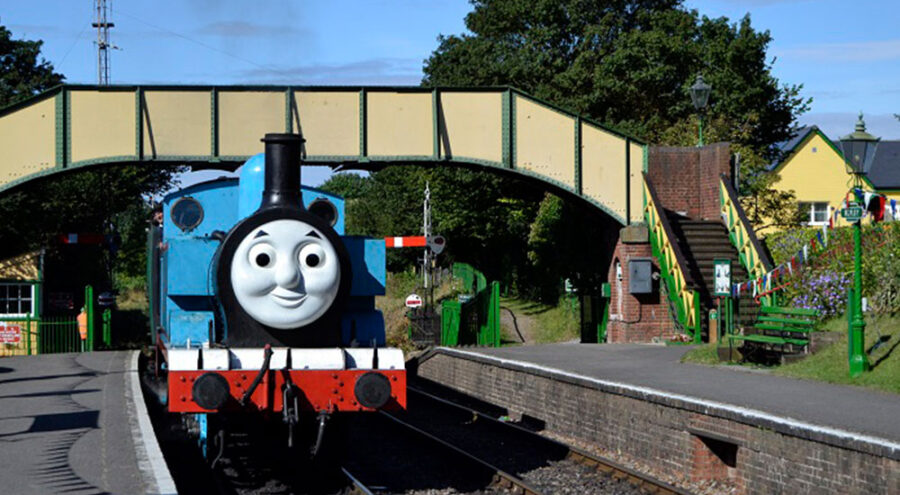
Thomas the Tank Engine

Status: Operational. Thomas is the No. 1 blue engine. He is a cheeky little engine who often gets into scrapes, usually by being over-eager to do things best left to bigger and more sensible engines. But clouds never last long in Thomas’ world and soon he’s bustling about again, playing his part in the yard and on his own branch line. Thomas works hard and he always strives to be a Really Useful Engine. Peep Peep!

Out of Service

850 – SR Lord Nelson Class ‘Lord Nelson’

Status: Awaiting Overhaul. The Southern Railway required a locomotive capable of hauling 500 ton trains at an average 55 M.P.H, but with severe restrictions imposed, the Chief Civil Engineer. R.E.L. Maunsell designed his “Lord Nelson” class to weigh little more than a “King Arthur” but with the highest tractive effort in Britain at that time. The engine is notable for its crank settings of 135° instead of the more normal 90°. This gives the locomotive the eight exhaust beats per revolution of the driving wheels, which sounds as if she is travelling faster than other locomotive types at the same speed. No. 850

30499 – SR S15 Class

30499 is the second locomotive owned by the Urie Locomotive Society (30506 is the other). It was purchased in 1983 from Woodhams yard at Barry in South Wales. The engine is the oldest surviving locomotive built at the LSWR Works at Eastleigh, being constructed in May 1920. Its working life was mostly from Feltham shed in south west London. It also had a short period working on the GWR during the Second World War. Withdrawn in January 1964, it was taken to Barry scrapyard but was fortunate in being one of the 213 engines there to be saved from scrapping.

34007 – SR West Country Class ‘Wadebridge’

Status: Under Overhaul at Riley's Locomotive Engineers in Lancashire. 2026 target date for a return to service at the Watercress Line. Completed at Brighton in August 1945, No. 34007 is one of the “West Country” class engines designed by O.V.S Bulleid as a lighter version of his “Merchant Navy” locomotives, offering better route availability. Note the original numbering using the notation 21C, where the “2” refers to the axles in the leading bogie, the “1” to the trailing wheels and “C” to the three pairs of coupled wheels, the “West Country” class numbers starting at 101. This was derived from a French style of numbering. Wadebridge is one of

75079 – British Railways Standard Class 4MT

Status: Under Restoration. 75079 is a British Railways Standard Class 4 4-6-0 mixed traffic locomotive completed at Swindon in January 1956, one of a batch built for the Southern Region. Entering service at Exmouth Junction, it was soon allocated to Basingstoke, where it operated semi-fast passenger trains to Salisbury and Waterloo among other duties and destinations. During this period, a double chimney was fitted to improve performance. In 1963, it was re-allocated to Eastleigh from where it continued operating passenger services, including sometimes boat trains, and other duties until withdrawal in late 1966. In 1982, it was bought from Barry scrap yard with

34105 – SR West Country Class ‘Swanage’

Status: Under Overhaul. Like fellow classmate ‘Wadebridge’, ‘Swanage’ retained its air smoothed outer casing throughout its working life and was not rebuilt like ‘Bodmin’. She also retains her original innovative design features, such as air smoothed casing and steam reverser. Note ‘Swanage’ has retained a high sided tender with raves up to roof level to stop coal from falling over the side. Swanage is currently part overhauled and in store.

30828 – SR S15 Class

Status: Overhaul Required. E828 was one of a class of 25 heavy freight locomotives designed for the Southern Railway by the Chief Mechanical Engineer, R.E.L. Maunsell, at a cost of £10,500 each. The design was based on that used by his predecessor, R.W. Urie of the L.S.W.R. This had already proved successful, but Maunsell added improvements and modifications to Urie’s design, making it one of the most advanced freight engines of the period. Fifteen were outshopped from Eastleigh, including E828, which was built in July 1927, with a further ten of the class being built in 1936. The class was steadily withdrawn from

45379 – LMS Black 5

Status: Non Operational. The Mid-Hants Railway Preservation Society now owns a number of locomotives, including Stanier Black 5 No. 45379 and BR Standard 4 No. 75079. 45379 is one of the successful “Black Five” 4-6-0 mixed traffic locomotives designed by William Stanier. Built by Armstrong Whitworth of Newcastle in July 1937 and first allocated to Crewe, it moved to Rugby in 1948 at nationalisation, back to Crewe in 1956 and on to Bletchley in 1961. Although Black Fives remained in service until the last day of mainline steam forty years ago, 45379 moved to Willesden in 1964, from where it was withdrawn in

80150 – British Railways Standard Class 4MT Tank Engine

Status: Ongoing conservation programme and fabrication of parts underway. The most recent addition to the Mid Hants Railway fleet was acquired from Glamorgan Council in exchange for our ex-Bricklayers Arms turntable, which they intend to install at Barry as part of their plan to turn it into a mainline destination. After initially being based at Brighton, 80150 was allocated to Eastleigh shed and reportedly was later at Guildford, though there is some doubt about this. Mid Hants driver and former Eastleigh fireman Bob Cartwright remembers working van trains with 80150 in the 1960s and picking up watercress from Alresford, making the locomotive historically perfect for our line as well

73096 – British Railways Standard Class 5MT

Status: Non Operational. 73096 was built at the Derby Works in November 1955. It was used on the London Midland and Western Regions of British Railways and withdrawn from service in November 1967. Rescued from the scrapyard in July 1985, 73096 was returned to service in October 1993, following a major boiler overhaul and the construction of a new tender, based on the chassis from a Jubilee class tender. 73096 has now been withdrawn from service following the expiry of her 10 year boiler certificate.

53808 – SDJR No. 88 7F

Status: Non Operational - Awaiting Overhaul. SDJR 7F 2-8-0, No. 88 was built in 1925 at the Darlington locomotive works of Robert Stephenson & Co. and is one of only two that survive from the original 11 constructed. It now carries its BR number, 53808. It arrived at Woodham Brothers yard in 1964 and moved to the S&DRT base at the then Radstock depot. Restored from Barry scrapyard condition between 1970 and 1987 (mostly at Radstock and Minehead), the locomotive was in regular service with the West Somerset Railway until 2019. The locomotive moved to the Watercress Line on long-term hire in August 2020. When built,