


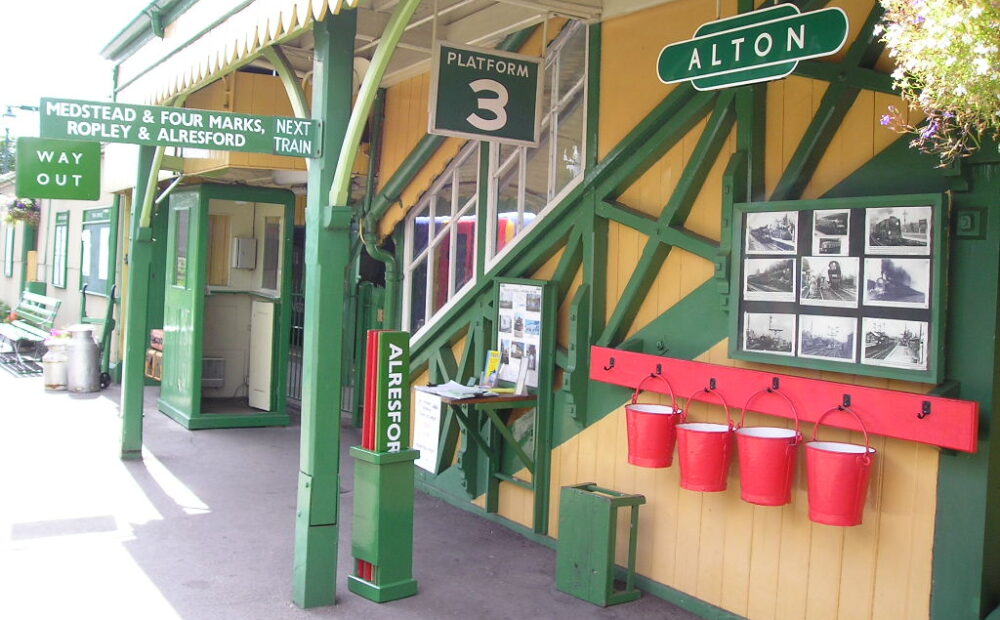
Alton is an ancient market town, mentioned in the Domesday Book. It grew up around a ford over the northern branch of the river Wey, which rises outside the town.
During the middle ages it was a staging post on the Saxon King’s Highway from London to Winchester, which followed the Wey to its source, climbed over the chalk ridge to the west of the town and then followed the rivers Alre and Itchen via Old Alresford to Winchester. A turnpike road through Alton via New Alresford to Winchester (the modern A31) was established in 1753 and another to Fareham and Gosport (the modern A32) shortly afterwards. The Swan Inn in the High Street was a noted coaching inn.
Hop growing originated in the area during the years after the Napoleonic Wars and the town became a substantial brewing centre. Alton’s water is considered to be second in quality only to that of Burton on Trent for brewing India Pale Ale. Two main breweries were established by the mid-nineteenth century, one owned by Henry Hall and the other by Abraham Crowley. Hall was a director of the Mid-Hants Railway and his brewery was served by an extensive complex of sidings. These firms were later taken over by Courage and Watney respectively. After about 1970 brewing was concentrated in a modern lager brewery and distribution centre on the Hall’s site, owned latterly by Molson Coors. Hop growing ceased in the late 1990s and brewing in Alton finally ceased in 2015.
The London & South Western Railway (LSWR) opened a branch line to Alton in 1852, to serve agricultural interests in the area. This ran from Guildford, via Ash, Tongham and Farnham, terminating in a field outside the town by the road to Worldham. A line from Farnham via Aldershot to Brookwood, on the LSWR main line, opened in 1870 and gave Alton a direct route to London Waterloo. Electric trains started using this route in July 1937 and at the same time the Tongham route closed.
The Alton, Alresford and Winchester Railway was promoted in 1861 by a consortium of local landowners and business men. It was known as the Mid-Hants Railway from 1865, opening in October of that year. A new station was build in Alton on the alignment of the new line and this is still in use today. The line was operated by the LSWR from the start and was purchased by that company in 1884. It was closed by British Railways in 1973 and the ten miles between Alton and Alresford are now owned and operated by the Watercress Line.
During the first half of the twentieth century the Butts, at the west end of Alton, was the site of a three way railway junction. In 1901 a light railway was opened from Alton to Basingstoke and in 1903 a considerably more substantial branch line was opened from Alton to Fareham via the Meon Valley. A third platform was provided at Alton to accommodate the new services and a new signal box was erected at the Butts to control the junction. The Basingstoke line had a chequered history, being closed in 1916, re-opened in 1924 and closed again (this time for good) in 1932. The Meon Valley line lasted until 1955.

